Years ago, a frozen forest in Alaska. No phone signal, nothing. Just the cold and the sky. The snow was packed hard under my boots and my breath froze on my collar, and the whole time I waited I was certain the lights were already up over the next ridge and I was missing them. A forecast will tell you a night looks promising. That's where it stops. At one in the morning the question you actually want answered is the one it leaves alone: is it happening right now, and is it happening near me?
The most reliable detector for that isn't in orbit. It's a person. Outside, head tilted back, watching the sky move. For most of the history of aurora chasing, that person had no way to tell anyone. Now they can, with a single tap.
A map made of people
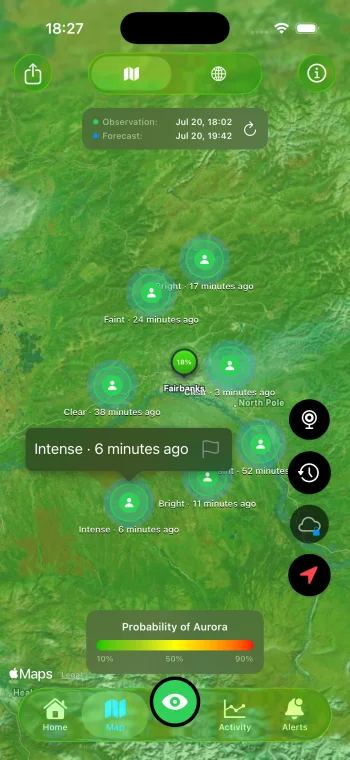
Open the map, zoom in, and you don't get a model's guess. You get people. Each green pin is someone who stepped outside in the last hour, looked up, and reported what they saw. One word for how strong: Faint, Clear, Bright, Intense. One timestamp for how fresh. Bright · 11 minutes ago. Intense · 6 minutes ago.
One line like that changes the whole feeling of a night. A low forecast, and three "Bright" pins an hour to the north: that's no longer a night to sleep through. A fine forecast with nothing nearby but "Clear · nothing yet": wait a little longer. It's the difference between a weather model and someone across town leaning out a window to say you should come see this.
Pull back, and watch the whole night
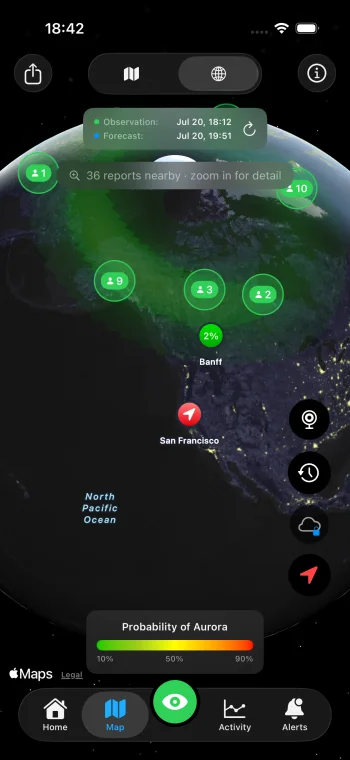
Zoom out and the pins gather into numbers. A 9 here. A 10 there. A quieter 2 off to one side. Under them, a running total of everyone out watching tonight. The auroral band rides around the dark side of the planet, and you can read the whole thing in one glance: where the skies are clear, where people are actually seeing something, whether it's drifting your way.
Your turn to be the signal
The map only works because people fill it in. So when the sky lights up, tap the report button and say how bright the lights are. It takes a second. That second becomes the pin that pulls someone two valleys over out of a warm cabin and into the cold, in time to catch it.
And the only thing you share is the sky. Sightings are anonymous. No name, no account, no profile. A person icon and an approximate place, never your doorstep. Just a quiet signal that someone close by is looking up at the same thing you are.
“That night in the forest, I had no signal. Just the cold and the sky. Now, on a good night, the map glows with other people, all of them looking up at once.”
The aurora has always rewarded the patient and the stubborn. It still does. What has changed is that you no longer have to guess alone in the dark about what the next valley can see. Your feet are still cold. You're just not the only one out here.